
Working on roofs - The right equipment and training
False security on roofs
The right equipment is not enough to make working on roofs safe. It is equally important to know how to use safety equipment to avoid accidents during snow removal. Today there is equipment and working methods that make risky work at height safer and more efficient. But more is needed. More knowledge is needed.
Avoid the most common mistakes on the roof - increase your security
Here is a short description of how to work more safely. The most common mistakes that cause accidents and incidents are selecting the wrong attachment point, using fall protection equipment errors and moving too far away from the anchor point. These mistakes are easy to avoid with the right knowledge and this is one of the things we teach and practise during our courses.
❌ERROR -The attachment point for the lanyard that will secure you if you fall is incorrectly selected.
✔️CORRECT - Carefully select a large, stable anchor point that will last. Look carefully!
Choosing too weak an attachment point will puncture the entire safety system on the roof. The anchor point where you attach your safety line must be able to withstand a weight of 12 knots - or as much as a small Nissan Micra. So drain valves, small fan pipes, etc. are out of the question. Choose larger and more stable attachment points such as a chimney or the base of the foundation of a fan room. Once you've chosen your attachment point, pull and tug on the rope, kick it a bit and make sure you've chosen something large and stable to attach your security system to. If you can't find anything good enough - choose an anchor point down on the ground on the opposite side of the roof you will be working on. This could be a car, a tree or something else large and stable. Be careful and choose the right one.
❌ERROR - The safety harness is combined with the wrong equipment.
✔️CORRECT - Check carefully what your harness will be combined with. Do not choose anything else.
The fall protection harness is a passive protection that works similarly to a seat belt. During work, it follows your movements. The harness is combined with a slide lock or fall arrest block that works in the same way. Responsive as you work, it then stretches and stops a fall if you slip or fall. Decide whether to work with a passive fall protection system or an active fall protection system. Choose equipment that belongs together. Do not combine between the different systems.
❌ERROR - The anchor point is too far away and you risk a pendulum fall.
✔️CORRECT - Move with the attachment point as you move. Think about the distance. Be careful!
If you move too far from your anchor point and forget to account for the pendulum effect in a fall, a small mistake can result in a pendulum fall. The risk of injury if you fall increases because the distance to the anchor point is too far away and the line is too long between you and the anchor point. To avoid a pendulum fall, move the anchor point with you as you move and keep track of the distance between you and the anchor point.
Tips! A clever alternative to working over a large width is to use double ropes attached diagonally from the edges of the work area. This allows you to work in complete safety without the risk of pendulum falls. An effective method that is taught on C2 courses, among others.
C2 Training Centre is Northern Europe's largest training centre. The centre is located in Uppsala and students come here from all over Sweden and parts of Europe. C2 Training Center is run by C2 Vertical Safety, which has many years of experience in equipment, training and work at height and is a leader in Sweden in training at height. C2 Training Centre is a certified Petzl Technical Institute and Petzl Technical Partner.
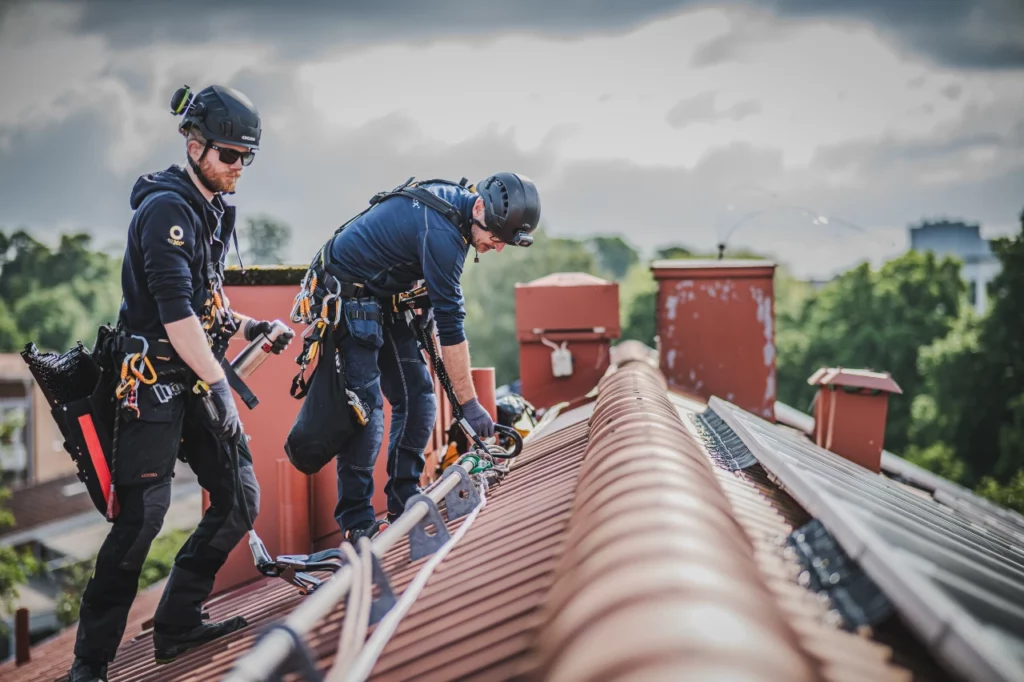
The right technology saves lives on roofs
The right technology and equipment can make work safer and reduce accidents. Every year, accidents and
incidents related to snow shovelling. Statistics from the Swedish Work Environment Authority indicate falls from roofs and from ladders,
falls through roofs, fractures of the back and foot after falls from roofs...
Training and practice provide safety and, not least, increased confidence. Practising situations that may occur on the roof, learning safe and effective ways of working, and knowing how to use the equipment is the basis of a safe way of working. The methods we teach are based on trying to use fall protection equipment as an aid and not just as protection. This is both a more efficient and safer way to work, the work goes faster and the wear and tear on your body is reduced. Being safe gives you peace of mind.
What are the most common errors?
The most common is carelessness and not recognising the situation.
seriously. You think "I'll just..." and don't bother using safety equipment. Or, thinking "I can do that - I am well trained and
strong" or think that they have long experience and do not need any safety equipment. In many cases, they are also unaware of modern lightweight equipment which, unlike the heavy and cumbersome ropes and hooks of the past, makes work easier, more efficient and safer.
Another common cause of incidents and accidents is not knowing or being unsure how to use the fall protection equipment you have. Perhaps
you connect the support rope at the fall protection point, putting an incorrect load on your body and making it easier to slip. Even if you do not fall, there are dangers in the "small" fall, such as injury or loss of equipment.
Education and training reduces risks and increases personal safety. The right equipment is not enough to make working on roofs safe. It is equally important to know how to use the safety equipment to avoid accidents when clearing snow on roofs.

Professional advice if you plan to shovel the roof yourself
Never work alone, buy a good rope and a harness. Leave axes, hammers and other sharp tools on the ground. If you intend to shovel snow off the roof yourself - listen to the advice of professionals first.
Working on a roof is always a risk. If it's steep, icy and slippery like this winter, the risks increase. If you have decided to shovel the snow from the roof yourself, be sure to be safe. Don't take chances, be careful and refrain if you are unsure.
Read this before going up on the roof:
Take care of yourself - and the roof.
Eight tips for safer snow removal on your own roof.
- Never work alone. Make sure there is always someone on the ground who can keep an eye on you. And who can quickly help or raise the alarm if you fall.
- Invest in a fall protection harness. Tying a rope around your waist and going to the roof is not okay. Invest in a fall protection harness. They don't cost much and give you a completely different level of safety.
- Secure yourself with a real rope - a rope intended for securing. If you don't know that you have a real rope - a safety rope - buy one. Remember that the rope is your safety if you fall.
- Always work with a stretched rope - If you have a stretched rope, the risk of falling is minimal. In addition, you are supported by the harness and rope and work better.
- Choose a stable attachment point for the rope. The rope that you attach to your safety harness should also be attached to something large, stable and heavy that will not give way if you fall. Tip, choose something on the ground on the other side of the roof you intend to shovel. That is, a car, a tree or something else large on the opposite side that you are working. When you have finished the first side of the roof, choose a new anchor point on the ground below the side of the roof that you just finished shovelling and then start shovelling the other side of the roof.
- Do not use sharp tools to remove snow from the roof. It is easy to damage the roof if you use an axe, hammer or any other sharp tool. Sheet metal roofs are easily dented, tile roofs are easily cracked and tarred roofs are damaged. If the roof is damaged, you have a new and much bigger problem than the snow you just shovelled away - a leaking roof that causes water damage.
- Start shovelling from the top. The vibrations of the roof can easily cause snow and ice to come loose. Start at the top so that snow and ice do not fall towards you when you are standing on the roof.
- Make sure it is clear underneath. Always check carefully that nothing is damaged when snow and ice fall from the roof.
