occupational health and safety consultation
Work at height, in confined spaces and other hazardous environments places high demands on the working environment, safety and planning.
Safer workplaces through the right skills and the right measures
At C2 Vertical Safety we have our own occupational health and safety engineers and specialists with extensive experience of working in complex and high-risk environments. We offer support throughout the entire process – from risk analyses and health and safety plans to training, contingency plans and follow-up. Through practical and operationally tailored occupational health and safety consultancy, we help companies create safe and sustainable workplaces. Our focus is always on complying with legal requirements, minimising risks and developing effective working methods that work in reality.
Do you have any questions regarding working environment you are welcome to book in one free of charge meeting with our occupational health and safety engineer

Our occupational health and safety consultancy services:
We offer qualified work environment consultancy with special expertise in working at height, fall risks, confined spaces, and other complex high-risk environments.
Our occupational health and safety engineers help you translate legal requirements, risk assessments and technical conditions into practical and functional solutions. Advice can be provided both in the planning phase and directly on-site in the operation.
Among other things, we can provide support within:
- Risk assessment and selection of appropriate protective measures
- Working methods for work at height and in confined spaces
- Selection and use of fall arrest and rescue systems
- Emergency preparedness, rescue planning and evacuation
- Requirements for competence, training and organisation
- Review of work preparation documents, routines and instructions
- Interpretation and practical application of work environment legislation, regarding AFS and relevant standards
The objective is to create solutions where safety, working methods, equipment and competence work together and are adapted to the actual working environment.
The right competence is a fundamental prerequisite for high-risk work to be planned and carried out safely. We offer both theoretical and practical training courses that are tailored to the operations' risks, working methods and the equipment used.
The training courses may include, among other things:
- Work at height and fall protection
- Rescue and evacuation from height
- Working in confined and enclosed spaces
- Confined space rescue
- Risk assessment and method statement
- Inspection and use of personal fall protection equipment
- Practical rescue exercises and scenario training
- Professional development for supervisors and staff with specific safety functions
We place great importance on participants not only understanding what needs to be done, but also why and how the safety measures are to be applied in their own operations.
We develop comprehensive fall protection plans and total solutions tailored to your business and work environment.
The process may include:
- Business analysis
- Risk assessment and documentation (according to AFS 2023:1, 2 and 2023:10 Chapter 4 protection against injury from falls)
- Routines and processes
- Development of preparedness plan / rescue plan (according to the Swedish Work Environment Authority's provisions AFS Section V: chemical risk sources, Chapter 7)
- Proposed improvement measures
- Method descriptions linked to EN363 personal fall protection systems
- Staff training
- Inspection and checking based on EN 365 and the instructions given in manuals and markings
Follow-up of improvement measures
As an external specialist, we participate in safety walkthroughs and security reviews to identify risks and areas for improvement within the organisation (in accordance with AFS 2023:1 Section 11).
We provide:
- Expertise in work related to working at height and confined spaces
- Identification of risk factors
- Proposed measures and improved routines and processes
- Support for work environment management and compliance both before and during changes to work
In the event of incidents or accidents, we help you conduct professional incident investigations focusing on learning and preventative measures.
During the investigation we go through
- Causes and underlying factors associated with the incident
- Improvement measures to reduce future risks
- 5 Whys, root cause analysis linked to MTO

We carry out risk assessments for work tasks and high-risk elements, for example:
- Working at height
- Confined spaces
- Confined spaces
- Rescue work
- Temporary workplaces
We also offer training in how to work with and draw up professional risk analyses.
We help you produce working environment plans tailored for projects and work involving particular risks in accordance with AFS 2023:3
Examples of areas:
- Working at height
- Confined spaces
- Fall risks
- Preparedness and safety procedures
- CDP-P – Construction Work Environment Coordination for Planning and Design
- CDS-P – Construction Work Environment Coordination for the Execution Stage
We help to ensure that work environment issues are addressed as early as the planning and design phase in order to minimise risks before work commences.
During the implementation of the project, we help to coordinate the working environment work at the workplace and ensure that the work is carried out safely and in accordance with applicable legislation.
We draw up emergency response plans/rescue plans in accordance with applicable requirements and standards for the work and work area in question.
The plans are adapted according to:
- Working environment
- Risk level
- Accessibility
- Rescue equipment
- Staff competence
A rescue or contingency plan needs to function even when a real incident occurs. Through practical and operationally tailored exercises, we help you verify that your organisation, staff, equipment and rescue methods work together.
The exercises may include, among other things:
- High-altitude rescue and evacuation
- Rescue from confined and restricted spaces
- Management of an injured or unconscious person
- Alarm chains, communication and allocation of responsibilities
- Use of rescue and evacuation equipment
- Collaboration between internal staff and external rescue resources
- Scenario-based exercises based on the organisation's identified risks
- Evaluation, feedback and improvement measures following a completed exercise
Following the completed exercise, the result can be used to identify shortcomings and develop preparedness plans, working methods, equipment and competence.
We review the business routines and processes to ensure that they:
- Complies with current legislation
- Meets occupational health and safety requirements
- Is practically functional in the operation
- Contributes to a safer workplace
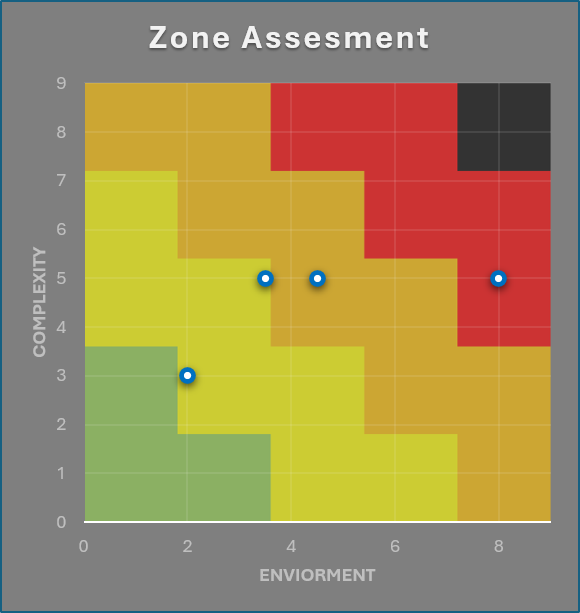
We analyse workplaces and work areas to ensure the correct level of safety and competence requirements.
Example:
- What rescue competence is required?
- What education is required?
- What equipment is suitable?
Why companies choose C2 Vertical Safety
- Specialist expertise in working at height and hazardous environments
- Practical and operationally adapted solutions
- Focus on both safety and efficiency
- Support from analysis to implementation and follow-up
- Consultants with experience from real working environments
Contact us

Do you want to strengthen your work environment management or do you need support with a specific project? Contact our occupational hygienist at joakim.tunje@c2safety.com or info@c2safety.com so we help you create a safer workplace.
Frequently asked questions
A risk assessment means that the employer investigates what risks of ill health and accidents exist in the work and assesses how serious the risks are. The risk assessment is a central part of the systematic work environment management and must help the employer to decide what measures need to be implemented.
Risk assessments must be documented in writing, and it must be clear what the risks are and whether they are serious.
Risk assessment is often used as a collective term for identifying and analysing risks in a job, a working method or at a workplace. In the Swedish Work Environment Authority's provisions, the term used above all is risk assessment.
A risk analysis can be used as a basis for the risk assessment by, for example, identifying hazards, potential events and consequences. When working at height, in confined spaces or in other hazardous environments, the risks need to be assessed based on the actual working conditions.
A risk assessment must clearly show which work environment risks have been identified and whether they are serious. Depending on the operations, the assessment may cover work tasks, sources of risk, possible consequences, probability, existing protective measures and the need for further measures, amongst other things.
For hazardous work, the risk assessment may also need to be supplemented with, for example, work instructions, method statements, competence requirements, selection of protective equipment and emergency preparedness.
A risk assessment must be in writing and show what risks exist and whether they are serious. The documentation should be sufficiently clear and practically useful to serve as a basis for decisions on measures.
For example, when working with fall risks, confined spaces or other particularly hazardous work operations, the assessment needs to be adapted to the workplace, the work task, the work method and the equipment that is actually to be used.
The employer must regularly examine the working environment conditions and assess the risks of ill health and accidents. A risk assessment must also be made when changes in operations are planned, for example in the event of changed work methods, new equipment or other changes that may affect the working environment.
The risk assessment must be carried out before the planned change is implemented so that risks can be prevented.
Yes. According to AFS 2023:1, risk assessments must always be documented in writing. The documentation must show which risks have been identified and whether they are serious.
This means that an oral walkthrough alone does not replace the required documented risk assessment.
It is the employer's responsibility to ensure that the work environment is investigated and that the risks are assessed. For example, managers, supervisors, safety representatives and affected employees can participate in this work.
If the organisation lacks sufficient expertise for systematic work environment management, the employer must engage occupational health services or equivalent expert help from outside.
The risk assessment should involve people who are familiar with the tasks and the actual working conditions. This could include, for example, a manager or supervisor, affected workers and safety representatives.
For complex or particularly hazardous work, specialist expertise may also be required in areas such as fall protection, ergonomics, chemical risks or other working environment fields.
The concepts are sometimes used in a similar way, but the Swedish Work Environment Authority's regulations primarily use the term risk assessment.
A risk analysis can be used to identify and analyse sources of risk, events and consequences. The risk assessment involves the employer assessing the risks of ill health and accidents, and documenting what the risks are and whether they are serious.
A working environment plan is a written document required for certain construction and civil engineering work. The plan is used to prevent working environment risks during the construction project and must contain the information required based on the project's organisation and risks.
The working environment plan must be drawn up early and developed as the project is planned and carried out.
A written working environment plan is required for construction and civil engineering work if any of the work with specific risks specified in AFS 2023:3 needs to be carried out or if the project is of such a scale that an advance notice must be submitted.
The assessment of whether a working environment plan is required therefore needs to be made based on both the scope of the project and the types of work and risks involved.
Bas-P, the client safety and health coordinator for the planning and design phase, shall draw up or have drawn up the working environment plan when such a plan is required. Work on the plan shall begin as soon as Bas-P has been appointed and planning and design have commenced.
The client is responsible for ensuring that a working environment plan is drawn up when required.
Before any initial construction or civil engineering work begins, the client-appointed safety coordinator for the planning phase (Bas-P) shall hand over the working environment plan and relevant information regarding the working environment management to the client-appointed safety coordinator for the execution phase (Bas-U).
Once the working environment plan has been handed over, the construction site safety supervisor (Bas-U) must, amongst other things, ensure that the plan is available at the construction site so that those working there can access it.
The Construction Work Environment Coordinator must also update the work environment plan based on how the work progresses, changes that occur, the work methods actually used and other changes that are significant for the work environment.
The working environment plan must be adapted to the current construction project and the requirements that apply to the project. Among other things, it can describe how the working environment work is organised and how work with special risks is to be managed.
For high-risk tasks, the plan may need to include or refer to specific preventative measures and working methods. The important thing is that the construction phase plan is project-specific and kept up to date throughout the course of the project.
The Client Coordinator for the planning and design phase (Bas-P) is responsible for coordinating health and safety issues during this stage and, among other things, must draw up or have someone draw up the health and safety plan when one is required.
Bas-U is the client representative for the implementation stage regarding working environment. Bas-U coordinates the working environment work during the construction phase and must, among other things, keep the working environment plan accessible and updated.
A safety walk is a practical method for systematically examining the working environment and identifying risks and deficiencies. During a safety walk, the workplace is reviewed to note things that could cause ill health or accidents.
The results can be used as a basis for risk assessments and decisions on work environment measures.
The employer shall regularly investigate the working environment conditions to assess risks of ill health and accidents. A safety walk is a common method for carrying out such investigations within the systematic work environment management.
Therefore, the crucial thing is not solely to carry out a certain activity known as a workplace safety inspection, but rather that the working environment is actually investigated and that identified risks are assessed and managed.
The employer is responsible for organising and carrying out the work environment management. In practice, therefore, a manager, supervisor, work environment officer or other person who has been assigned work environment tasks may be responsible for planning and convening the safety walkthrough.
The employer's overarching responsibility for the work environment remains even when work environment tasks are distributed within the organisation.
Who should participate depends on the operations and the risks to be investigated. Representatives of the employer and employees usually take part, for example a manager or supervisor and a safety representative.
In the case of specific work environment risks, it may also be appropriate to include people with specialist knowledge in areas such as machine safety, fall protection, ergonomics or other relevant fields.
There is no general requirement in AFS 2023:1 for a specific number of safety walkthroughs per year for all workplaces. However, the employer must regularly examine the working environment conditions.
How often surveys and safety walkthroughs need to be carried out therefore depends on the activities, risks and changes in the workplace. Operations with large or rapidly changing risks may need more frequent checks.
A near miss is an event or situation that could have resulted in ill health or an accident. An example could be an object falling from a height without hitting anyone, a person nearly falling, or an equipment fault that creates a dangerous situation.
Near misses are important signals in occupational health and safety work because they can indicate risks before a serious accident occurs.
Incident is a broader term that organisations often use for unwanted events, accidents and near misses. The Swedish Work Environment Authority's regulations use terms such as occupational accidents and near misses, among others.
An internal incident report can be an effective way to capture events and shortcomings that need to be investigated or addressed.
Incident is often used as a collective term for unwanted events. A near miss is an event that could have led to ill health or an accident, but where the feared harm did not occur.
For health and safety work, it is important not only to record incidents but also to identify underlying causes and prevent them from happening again.
An incident investigation is a structured review of what happened, why it happened, and what measures need to be implemented to reduce the risk of something similar happening again.
According to AFS 2023:1, the employer must investigate the causes if an employee suffers from ill health or an occupational accident, or if a serious incident occurs. The focus shall be on preventing future risks.
An incident report documents an undesirable event. For example, it can describe what happened, when and where it occurred, what work activities were underway, what risks were identified and what immediate or preventive measures have been taken.
A good incident report provides the basis for further investigation, risk assessment and follow-up.
Incident management involves organisations working systematically to report, assess, investigate, remedy, and follow up on incidents and near misses.
The aim is not only to document what has already happened, but to find root causes and take action to prevent new accidents and incidents.
An occupational health and safety consultant helps employers and organisations identify and assess work environment risks and develop measures for a safer and more sustainable work environment.
The work may include, for example, risk assessments, safety rounds, incident and near-miss investigations, work environment procedures, training, work preparations and support in the systematic work environment management.
C2 offers specialist expertise in working at height, fall protection, confined spaces and other high-risk working environments.
External occupational health and safety expertise may be relevant when the organisation lacks sufficient internal expertise for a specific risk or work environment issue. This may involve, for example, complex risk assessments, work at height, fall protection, confined spaces or investigations following a serious incident.
According to AFS 2023:1, the employer must engage occupational health services or corresponding expert assistance from outside when the expertise within the organisation itself is not sufficient for the systematic work environment management.
An occupational health and safety consultant can help the employer to investigate the work environment, identify risks and produce documentation for the risk assessment. Specialist support can be particularly valuable when the work involves risks that require special knowledge or experience.
However, employing external expertise does not mean that the employer's responsibility for the work environment disappears.
C2 can support companies with planning and risk assessment for high-risk work, such as work at height, fall hazards and work in confined spaces.
The support can be adapted to the workplace and the assignment and, for example, include risk assessment, work method, fall protection solution, rescue preparedness and training needs. The goal is to create practically workable methods where risks are identified and managed before work is carried out.